Isolation, locks and deadlocks in PostgreSQL: what happens when transactions fight over the same row
READ COMMITTED, REPEATABLE READ and SERIALIZABLE in practice: lost update, write skew, row and table locks, ALTER TABLE's lock queue, SKIP LOCKED, advisory locks and deadlocks, with reproducible experiments.

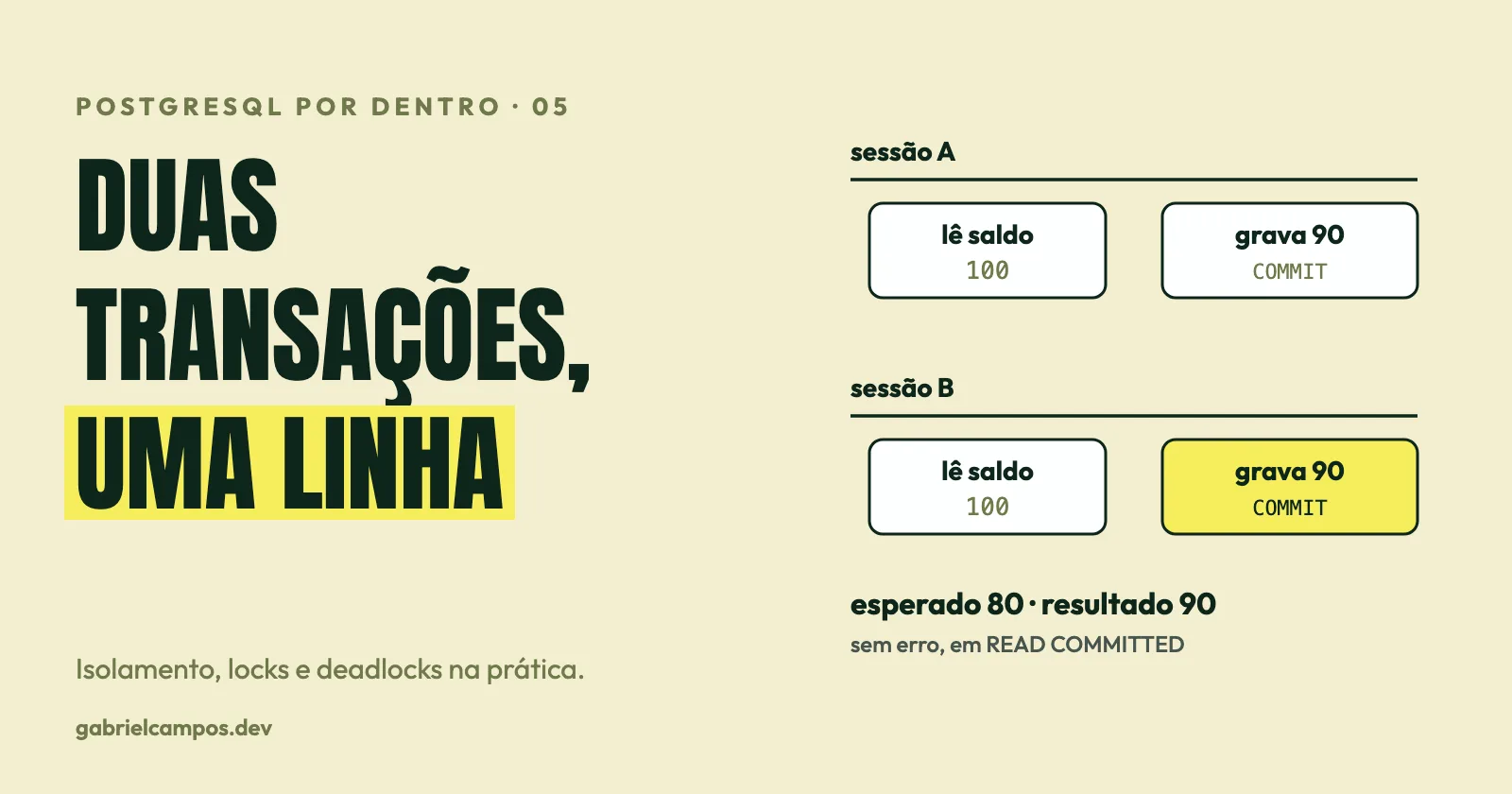
Two transactions read a balance of 100, each subtracts 10 and writes the result. The final balance should be 80. In a test I ran under READ COMMITTED, PostgreSQL’s default, it ended at 90: one of the subtractions simply vanished, with no error at all. With an atomic UPDATE account SET balance = balance - 10, the same scenario gave 80.
Concurrency is the part of the database where “it works on my machine” fails the most. This is the fifth article in the PostgreSQL Internals series, and the first that depends on you opening two sessions to understand it. All the scenarios below were run on a local PostgreSQL 17.10, with concurrent sessions simulated through psql and pg_sleep.
This article is a study based on the official documentation and on disposable local experiments. Passages marked as opinion reflect my own reading. References are at the end. The experiments depend on timing (
pg_sleep); the behavior described is the deterministic one, and the measured times are illustrative.
Isolation: the contract, and what PostgreSQL implements
The SQL standard defines four isolation levels by the anomalies each one may allow. PostgreSQL implements three distinct levels, via MVCC (see the article on MVCC):
| Level | When the snapshot is taken | Possible phenomena in PostgreSQL |
|---|---|---|
READ COMMITTED (default) |
at each statement | non-repeatable read, phantom, serialization anomaly |
REPEATABLE READ |
at the transaction’s first command | serialization anomaly (e.g. write skew); no phantom reads |
SERIALIZABLE |
same, plus SSI detection | none; but may fail with a serialization error |
Two documented facts that tend to cause confusion: READ UNCOMMITTED behaves like READ COMMITTED (there is no dirty read in PostgreSQL), and PostgreSQL’s REPEATABLE READ doesn’t allow phantom reads, going beyond the standard’s minimum. That is PostgreSQL-specific behavior, not the SQL standard’s; in other databases, the same level name can carry different guarantees.
READ COMMITTED and the read-modify-write “lost update”
The most common code pattern that generates inconsistency is to read, compute in the application and write back:
-- Sessions A and B, both in READ COMMITTED
BEGIN;
SELECT balance FROM account2 WHERE id = 1;           -- both read 100
-- (the application computes 100 - 10 = 90)
UPDATE account2 SET balance = 90 WHERE id = 1;       -- both write 90
COMMIT;
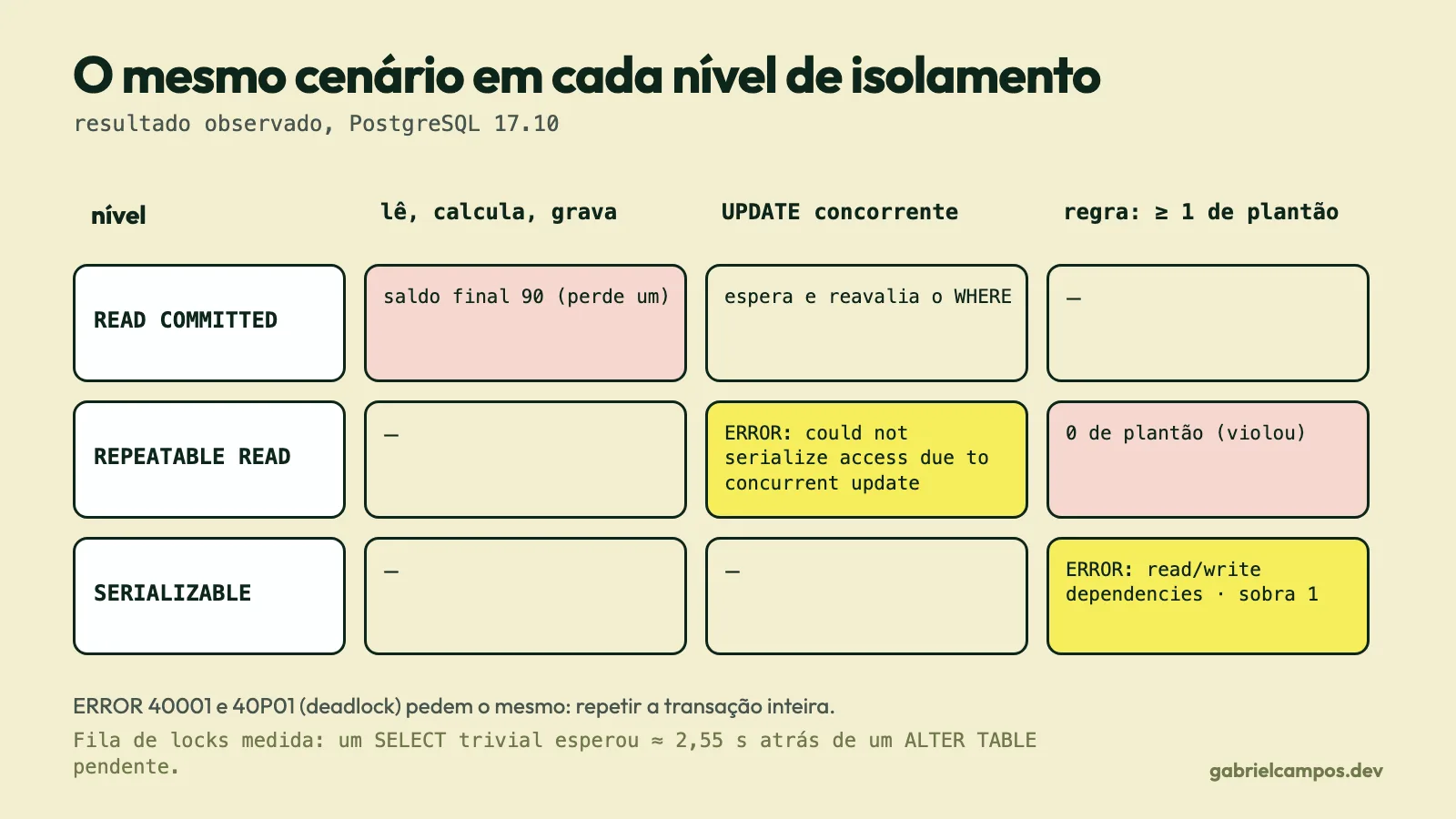
Measured result: final balance 90, when the correct one would be 80. The database didn’t get it wrong: each transaction followed the rules of the level; the SELECT simply didn’t lock anything. There are three classic fixes:
- Do the calculation in the database:
UPDATE account2 SET balance = balance - 10 WHERE id = 1. In the same test with that form, the result was 80. The second transaction waited for the first to commit and then re-evaluated the updated row. The documentation describes this behavior: if the row was changed by another transaction that committed, “the command’s search condition (theWHEREclause) is re-evaluated to see if the updated version of the row still matches” and theUPDATEproceeds on the new version. - Lock the row before reading:
SELECT balance FROM account2 WHERE id = 1 FOR UPDATE. - Use a higher level (
REPEATABLE READorSERIALIZABLE) and handle the failure with a retry.
The documentation also shows a subtle consequence of re-evaluation: the WHERE is re-evaluated only on the row that was being updated, which can produce results that no serial order would produce (the official example uses UPDATE website SET hits = hits + 1 concurrent with a DELETE ... WHERE hits = 10, and the DELETE has no effect).
REPEATABLE READ: fail instead of overwrite
Under REPEATABLE READ, the transaction works on a fixed snapshot. If it tries to update a row that another transaction already updated and committed after the snapshot, PostgreSQL doesn’t re-evaluate: it aborts. I reproduced it like this:
-- Session A
BEGIN ISOLATION LEVEL REPEATABLE READ;
SELECT balance FROM account2 WHERE id = 1;           -- 100 (snapshot fixed)
SELECT pg_sleep(2);

-- Session B (while A sleeps): UPDATE ... SET balance = balance - 5; commit

-- Session A
UPDATE account2 SET balance = balance - 10 WHERE id = 1;
-- ERROR:  could not serialize access due to concurrent update
This error is expected behavior, not a bug. The documentation tells the application to “abort the current transaction and retry the whole transaction from the start”. Read-only transactions under REPEATABLE READ never suffer serialization conflicts.
The limit of REPEATABLE READ: write skew
Serialization anomalies that don’t involve the same row escape REPEATABLE READ. The classic example is the doctors’ on-call roster: the business rule is “always at least one doctor on call”. Ana and Bia are on call; each one, in a transaction, checks that there are two doctors and then takes herself off the roster. Both checks pass, both writes hit different rows, and no row conflict is detected.
BEGIN ISOLATION LEVEL REPEATABLE READ;
SELECT count(*) FROM on_call WHERE is_on_call;      -- 2 in both sessions
-- ... pause ...
UPDATE on_call SET is_on_call = false WHERE doctor = :me;
COMMIT;
Result measured under REPEATABLE READ: 0 doctors on call at the end, with both transactions committed. The business rule was violated without any error.
Repeating exactly the same experiment under SERIALIZABLE:
ERROR:  could not serialize access due to read/write dependencies among transactions
DETAIL:  Reason code: Canceled on identification as a pivot, during write.
HINT:  The transaction might succeed if retried.
One of the transactions was cancelled; 1 doctor remained on call, exactly what the rule requires. PostgreSQL’s SERIALIZABLE uses SSI (Serializable Snapshot Isolation): it doesn’t block more, but tracks read/write dependencies between concurrent transactions with predicate locks (visible in pg_locks as SIReadLock) and aborts one of the involved ones when it detects a dangerous cycle. According to the documentation, these locks “do not cause any blocking and therefore cannot play any part in causing a deadlock”.
Practical consequences:
SERIALIZABLErequires retry logic in the application. The error hasSQLSTATE 40001(serialization_failure), the same as theREPEATABLE READone above.- There are false positives: SSI may cancel a transaction that wouldn’t have violated anything, because it is conservative.
- The documentation warns that, even when checking beforehand whether a key exists, “it is possible to see unique constraint violations caused by conflicts with overlapping Serializable transactions”.
Opinion: in systems with business rules that span several rows (limits, quotas, “at least one”, “at most N”), I prefer to treat
SERIALIZABLEwith retry as the first candidate, and explicit locks as the alternative when the cost of retry is high. The decision is domain-driven: there is no “safe by default” level without a corresponding cost.
Locks: what is actually locked
MVCC eliminates most of the blocking between readers and writers, but not all of it. There are three families of locks worth telling apart.
1. Row locks
Row locks block only writers and other lockers of the same row, never ordinary reads. Four modes (ch. 13.3.2), from strongest to weakest:
| Mode | Acquired by | Blocks |
|---|---|---|
FOR UPDATE |
DELETE; UPDATE that changes key columns; SELECT ... FOR UPDATE |
everything below |
FOR NO KEY UPDATE |
UPDATE that does not change key columns |
all except FOR KEY SHARE |
FOR SHARE |
SELECT ... FOR SHARE |
UPDATE, DELETE, FOR UPDATE, FOR NO KEY UPDATE |
FOR KEY SHARE |
foreign key check; SELECT ... FOR KEY SHARE |
DELETE, FOR UPDATE, updates that change a key |
PostgreSQL records the row lock in the tuple itself (in xmax, as we saw in the MVCC article) and doesn’t keep an in-memory list, so there is no “lock escalation” and no limit on rows locked per transaction. The flip side, in the documentation’s words: locking a row “may cause a disk write”.
An experiment shows the subtlety of foreign keys. Transaction 1 inserts a row into child (which references parent(id = 1)), which takes FOR KEY SHARE on the parent and stays open:
UPDATE parent SET name='b' WHERE id=1   → waited 0.05 s   (FOR NO KEY UPDATE doesn't conflict with KEY SHARE)
SELECT ... FROM parent WHERE id=1 FOR UPDATE → waited 1.47 s  (conflicts)
Without the NO KEY UPDATE and KEY SHARE modes, updating any non-key column of a parent would block inserts of children. They were created precisely to avoid that.
2. SKIP LOCKED, NOWAIT and queues
By default, SELECT ... FOR UPDATE waits. Two variants change that:
SELECT id FROM queue WHERE id = 1 FOR UPDATE NOWAIT;
-- ERROR:  could not obtain lock on row in relation "queue"

SELECT id FROM queue ORDER BY id FOR UPDATE SKIP LOCKED LIMIT 2;
-- with id=1 locked by another session: returned 2 and 3
SKIP LOCKED skips rows that are already locked and is the basis of queue patterns on SQL tables, with several workers pulling work without blocking each other. The documentation describes it as suitable for this case, but notes that it gives an intentionally inconsistent view of the data. The Shopify case study covered on this blog uses exactly this mechanism (in MySQL).
3. Table locks
Every command acquires some table lock. The documentation’s eight modes form a conflict matrix; the ones that matter most in production:
| Lock | Typical of | Conflicts with |
|---|---|---|
ACCESS SHARE |
SELECT |
only ACCESS EXCLUSIVE |
ROW EXCLUSIVE |
INSERT, UPDATE, DELETE |
SHARE and above |
SHARE UPDATE EXCLUSIVE |
VACUUM, ANALYZE, CREATE INDEX CONCURRENTLY |
itself and SHARE and above (doesn’t block DML) |
SHARE |
CREATE INDEX (without CONCURRENTLY) |
blocks writes |
ACCESS EXCLUSIVE |
DROP TABLE, TRUNCATE, VACUUM FULL, many ALTER TABLEs |
everything, including SELECT |
The documentation’s tip deserves emphasis: only ACCESS EXCLUSIVE blocks a plain SELECT. And here lies one of the most common production traps.
The lock queue: a waiting DDL also blocks whoever arrives after it
Locks are granted in queue order. If an ALTER TABLE migration (which asks for ACCESS EXCLUSIVE) has to wait for a long transaction reading the table, the SELECTs that arrive after it wait behind it, even though they are compatible with the long transaction. I reproduced it:
Session 1: BEGIN; SELECT count(*) FROM account2; SELECT pg_sleep(4);   -- holds ACCESS SHARE
Session 2: SET lock_timeout = '3s'; ALTER TABLE account2 ADD COLUMN x int;   -- joins the queue
Session 3: SELECT count(*) FROM account2;   -- a trivial SELECT

Result: the trivial SELECT waited ≈ 2.55 s
        the ALTER TABLE failed: ERROR: canceling statement due to lock timeout
The SELECT doesn’t conflict with session 1; it waited because it joined the queue behind the pending ALTER TABLE. The standard defense is a short SET lock_timeout on every migration, with retry. The parameter’s default value is 0 (no limit), as I verified with SHOW lock_timeout. For monitoring, pg_blocking_pids(pid) and the pg_locks view (granted column) show who is waiting for whom.
4. Advisory locks
These are locks whose meaning is defined by the application: the database only guarantees mutual exclusion over a number (or a pair of numbers). The documentation recommends them for pessimistic locking patterns that fit MVCC poorly, and says they are “faster, avoid table bloat, and are automatically cleaned up by the server at the end of the session”.
SELECT pg_try_advisory_lock(42);        -- f, if another session already holds key 42
SELECT pg_advisory_xact_lock(42);       -- transaction level: released at COMMIT/ROLLBACK
Documented cautions:
- Session level ignores transactions: a lock acquired in a transaction that later rolls back stays held. Locks accumulate: each acquisition requires an unlock.
- They share the lock table’s memory (sized by
max_locks_per_transaction× connections). Exhausting it prevents the server from granting any lock. - In
SELECT pg_advisory_lock(id) FROM foo WHERE ... LIMIT 100, theLIMITmay not be applied before the function; use a subquery. Unexpected locks stay “dangling” until the end of the session. - In transaction-mode poolers (PgBouncer, for example), session locks are dangerous, because the same server session is reused by different clients. Prefer the
xactvariant.
Deadlocks
A deadlock occurs when each transaction waits for a lock the other holds. PostgreSQL detects it automatically: after a wait exceeds deadlock_timeout (default 1 s, as I confirmed with SHOW), it checks the wait graph and, if there is a cycle, aborts one of the transactions.
I reproduced it with two transactions updating the same two rows in opposite order:
-- A: UPDATE ... WHERE id=1;   sleep;   UPDATE ... WHERE id=2;
-- B: UPDATE ... WHERE id=2;   sleep;   UPDATE ... WHERE id=1;
ERROR: deadlock detected
DETAIL: Process 68871 waits for ShareLock on transaction 902; blocked by process 68882.
Process 68882 waits for ShareLock on transaction 901; blocked by process 68871.
HINT: See server log for query details.
CONTEXT: while updating tuple (0,10) in relation "account2"Notice that the wait is for a ShareLock on the transaction (902, 901), not on the row: that is how PostgreSQL implements waiting on a row conflict. Which transaction is aborted is, according to the documentation, “difficult to predict and should not be relied upon”. The SQLSTATE is 40P01 (deadlock_detected), distinct from the serialization 40001. In both cases, the correct response from the application is the same: retry the whole transaction.
How to prevent it, according to the documentation (ch. 13.3.4):
- Acquire locks on multiple objects always in the same order in every part of the application. In a balance transfer, update the lower
idfirst, for example. - Take the most restrictive mode needed on each object first (avoid
SELECT ... FOR SHAREfollowed byUPDATE). - Keep transactions short. Transactions that wait for user input or external calls hold locks indefinitely.
- When you can’t guarantee it, retry.
For investigation, log_lock_waits = on logs waits that exceed deadlock_timeout, and the log messages carry the two queries involved. In PostgreSQL 18, according to the release notes, log_lock_failures also logs SELECT ... NOWAIT failures.
Common pitfalls
- Read-modify-write in the application under
READ COMMITTED: silent lost update. - Treating error
40001or40P01as a fatal failure instead of a retry. UnderREPEATABLE READ/SERIALIZABLEthese errors are part of the contract. - Retry without idempotency: repeating a transaction that also called an external service duplicates the external effect.
- Migrations without
lock_timeout: the queuedALTER TABLEcan take down the entire application, as shown. - Thinking
SERIALIZABLEis just “slower”. It requires redesigning for retry and can raise the abort rate under high contention. - Session-level advisory locks through a pooler.
- Confusing a row lock with a table lock.
SELECT ... FOR UPDATEtakesROW SHAREon the table; heavy DDL (ACCESS EXCLUSIVE) conflicts with it. - An open transaction waiting on HTTP. It holds locks and the vacuum horizon (see the article on VACUUM).
Practical recommendations
- Whenever possible, put the logic in the
UPDATE(balance = balance - x), not read-compute-write. - For invariants across several rows, choose between
SERIALIZABLEwith retry orSELECT ... FOR UPDATEin a fixed order. - Implement a generic retry for
40001and40P01, with a limit and backoff. - Set
lock_timeout(andstatement_timeout) in migrations and maintenance tools; consideridle_in_transaction_session_timeout. - Use
FOR UPDATE SKIP LOCKEDfor table queues, andNOWAITwhen failing fast is better than waiting. - Monitor
pg_stat_activity.wait_event_type = 'Lock'andpg_lockswithgranted = false. - Prefer transaction-level advisory locks, and document the meaning of each key.
Frequently asked questions
What is PostgreSQL’s default isolation level?
READ COMMITTED.
Does SELECT FOR UPDATE block reads?
No. Ordinary reads continue without blocking; it blocks other writers and lockers of the same row.
Is SERIALIZABLE equivalent to running transactions one at a time?
The result is guaranteed to be equivalent to some serial order, but the transactions run concurrently and can be aborted to ensure that.
How does PostgreSQL choose the victim of a deadlock? The documentation says it is hard to predict and that you shouldn’t depend on it.
Do I need to handle deadlocks if I lock in a consistent order? A consistent order reduces them a lot, but doesn’t eliminate every case (indexes, FKs, triggers, implicit locks). Keep the retry.
Does pg_advisory_lock work across different database instances?
No. It only holds within a single PostgreSQL server; physical replicas don’t share the state of these locks.
Conclusion
The biggest lesson from the experiments is that the three isolation levels are not steps of “safety”, but different contracts about when you will see an error instead of wrong data. Under READ COMMITTED, the database silently allows the lost read-modify-write; under REPEATABLE READ, it aborts same-row conflicts but lets write skew through; under SERIALIZABLE, it aborts that case too, and the bill reaches the application in the form of a retry code. Row, table and advisory locks are the explicit tools for the rest. In the next article, the changes in PostgreSQL 18, including the ones that affect this behavior.
References
This article is a study based on the sources below. Passages marked as opinion reflect my own reading. The experiments were run on a local PostgreSQL 17.10.
- PostgreSQL Documentation 17, 13.2. Transaction Isolation
- PostgreSQL Documentation 17, 13.3. Explicit Locking
- PostgreSQL Documentation 17, 13.4. Data Consistency Checks at the Application Level
- PostgreSQL Documentation 17, SELECT: The Locking Clause
- PostgreSQL Documentation 17, Appendix A. PostgreSQL Error Codes (
40001,40P01) - PostgreSQL Documentation 17, 28.2 /
pg_locks - PostgreSQL Documentation 18, Release Notes: PostgreSQL 18 (
log_lock_failures) - Ports, D. R. K.; Grittner, K. Serializable Snapshot Isolation in PostgreSQL. Proceedings of the VLDB Endowment, v. 5, n. 12, 2012. arXiv:1208.4179
Need technical support for your software architecture or systems?
I build resilient custom web systems, high-throughput API integrations, and performance diagnostics. Direct collaboration with the engineer, zero intermediaries.
Related Articles
MVCC in PostgreSQL: why an UPDATE never overwrites the row
How PostgreSQL implements MVCC: tuple versions, xmin/xmax, snapshots, hint bits, HOT, and the link to VACUUM. With reproducible experiments using pageinspect.
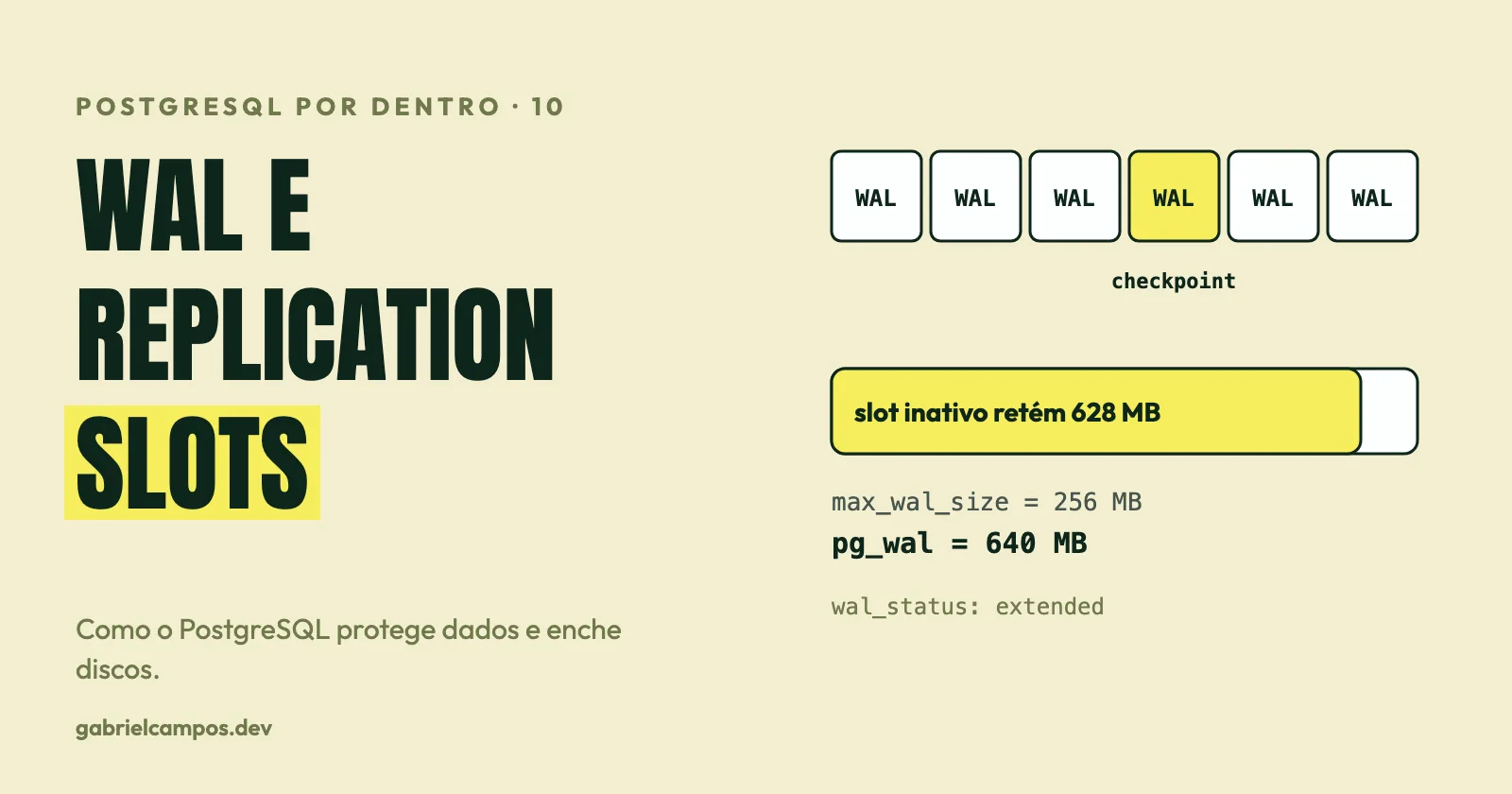
WAL, checkpoints and replication slots: how PostgreSQL protects your data (and how a forgotten slot fills the disk)
Write-Ahead Logging, full-page writes, checkpoints, crash recovery, streaming and logical replication, lag and WAL retention: how each piece works and how an abandoned replication slot becomes an incident. With experiments.