Legacy Systems: Modernizing Without Rewriting from Scratch
Why big-bang software rewrites fail and how to modernize legacy codebases incrementally via Strangler Fig, characterization tests, and anti-corruption layers.

Every successful software system eventually becomes a legacy system. It continues processing customer orders, generating enterprise revenue, and running mission-critical operations, yet every feature modification costs three times what it should, few developers understand its internal state machine, and nobody dares modify core modules.
The instinctive developer reaction is declaring that the entire system must be rewritten from scratch. In this article, drawing on insights from Joel Spolsky, Martin Fowler, Michael Feathers, and Thoughtworks, I explain why complete rewrites are almost invariably a disastrous strategic choice, and how to modernize legacy platforms incrementally while delivering tangible business value every step of the way.
What a legacy system actually is
There are two practical definitions. The business definition: a production system that delivers indispensable business value, but is brittle, risky, and expensive to modify. The engineering definition, formulated by Michael Feathers in Working Effectively with Legacy Code (2004): legacy code is simply code without automated tests.
Feathers’ definition is profoundly liberating. It shifts the diagnostic question from “is this programming language old?” to “can our engineering team modify this behavior with testable confidence?”. A decade-old codebase backed by comprehensive regression test coverage is significantly less “legacy” than a greenfield microservice deployed last month with zero test coverage.
The siren song of the total rewrite
In April 2000, Joel Spolsky published Things You Should Never Do, Part I, analyzing Netscape’s fateful strategic decision to scrap their browser codebase and rewrite it from scratch. Spolsky called a ground-up rewrite the single worst strategic mistake a software company can commit, explaining why: old code has already been empirically tested in production. Those convoluted, ugly branches that nobody understands are, overwhelmingly, hard-won bug fixes resolving edge-case production anomalies discovered over years of real-world use. Code does not rust or accumulate bugs simply by sitting on a storage volume.
Martin Fowler echoes this in his 2024 revision of Strangler Fig: the proposal to replace an entire legacy system in a single monumental release, as straightforward as it sounds on an executive slide deck, ends in failure the vast majority of the time. He highlights two structural reasons: rebuilding a complex enterprise platform takes vastly longer than anticipated, during which the business cannot pause feature development; furthermore, a large percentage of legacy behaviors earmarked for recreation are no longer needed by modern users.
Thoughtworks, in their technical paper Patterns of Legacy Displacement (Ian Cartwright, Rob Horn, and James Lewis, 2024), identifies the trap of feature parity: the dogmatic requirement that the replacement system must replicate 100% of historical legacy behaviors. Documenting every obscure edge case in a 20-year-old system is an immense sink of engineering capital, and the quest for feature parity drives teams into a “big bang” cutover that concentrates catastrophic operational risk into a single release window.
Before touching code: establish outcomes and boundaries
Modernization is not an end in itself. Before choosing software patterns, answer these business questions:
- What concrete business outcome is targeted? Slashing cloud hosting bills, accelerating release cycles, migrating off unsupported end-of-life runtime platforms, or complying with new statutory regulations?
- Which modules undergo frequent business changes? Modernization pays its highest dividend where developer velocity is currently bottlenecked.
- Which operational workflows are non-negotiable? Which specific features must never fail under any circumstance?
- Where does authoritative data live, and who consumes it? Undocumented external integrations, ETL scripts, spreadsheets, and batch cron jobs are routinely uncovered late in migrations.
Thoughtworks outlines four ongoing, iterative disciplines: understanding desired business outcomes, decomposing the problem space into small modular increments, delivering those increments iteratively to production, and evolving organizational structures to sustain them. The authors stress that software technology accounts for only half the challenge; the other half is operational methodology, team structure, and engineering leadership.
The safety net: characterization testing
Before modifying legacy behavior, you must establish what the system actually does today. Feathers coined the term characterization tests to describe automated tests that capture current real-world software behavior, rather than ideal intended behavior. If the legacy code contains an obscure bug, the characterization test asserts that bug. Correcting the bug occurs later as a conscious, deliberate refactoring step.
import { describe, expect, it } from 'vitest';
import { calculateShipping } from '../legacy/shipping';

// Characterization test: captures current real-world behavior, even if unintuitive.
describe('calculateShipping (current behavior)', () => {
  const cases = [
    { zip: '90210', weightKg: 0.5, expected: 18.9 },
    { zip: '90210', weightKg: 10, expected: 42.3 },
    // The legacy code returns 0 for negative weights instead of throwing an error.
    // We document and preserve this behavior until we explicitly decide to change it.
    { zip: '90210', weightKg: -1, expected: 0 },
  ];

  for (const { zip, weightKg, expected } of cases) {
    it(`ZIP ${zip}, ${weightKg} kg`, () => {
      expect(calculateShipping(zip, weightKg)).toBe(expected);
    });
  }
});
Expected assertions are not invented: they are captured directly by executing the legacy code against realistic inputs. An effective technique involves capturing anonymized production payloads and replaying them against the modernized service implementation.
The Strangler Fig pattern: incremental displacement
The name originates from Fowler’s travels in the Queensland rainforests of Australia in 2001. Strangler fig seeds germinate in the upper branches of a host tree, gradually sending roots downward to the forest floor until the fig encloses and ultimately replaces the host tree.
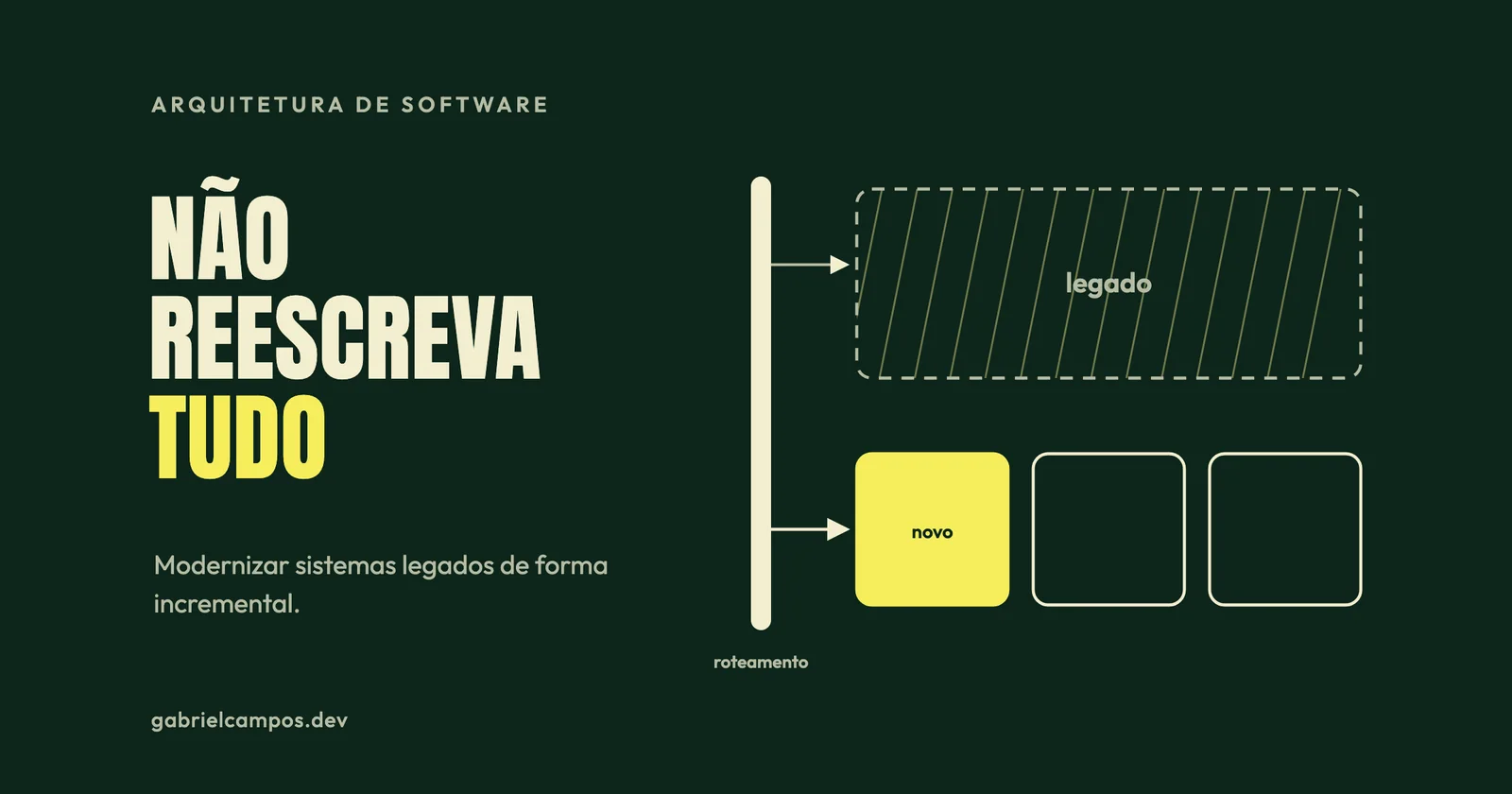
Applied to software architecture: rather than shutting down the legacy system, you place an edge reverse proxy or API gateway in front of it, selectively routing targeted endpoints to new services, one bounded feature at a time.
# Routing layer in front of the legacy application
location /api/v2/orders/ {
    proxy_pass http://new-order-service;
}

location / {
    proxy_pass http://legacy-system;
}
Over time, more routes migrate to modernized services, and the legacy footprint shrinks until it can be safely decommissioned. Fowler emphasizes that this approach requires an explicit transitional architecture: code and integration scaffolding whose sole purpose is allowing old and new systems to coexist temporarily, destined for eventual removal. Teams often balk at this temporary scaffolding, but the drastic reduction in operational risk and the ability to release value early easily justify the investment.
Additional migration patterns
- Branch by Abstraction: introduce an abstract interface around the internal legacy subsystem, refactor existing code to call this interface, and subsequently swap in the new implementation behind feature flags. Ideal for in-process refactoring within a monolithic codebase.
- Event Interception: capture database state mutations from the legacy system via Change Data Capture (CDC) and stream them asynchronously to modern downstream consumers.
- Legacy Mimic: design the replacement system to mirror legacy external interfaces so upstream dependencies remain oblivious to the internal transition.
- Divert the Flow: extract high-visibility cross-organizational workflows out of the legacy platform first to unblock dependent teams.
- Anti-Corruption Layer (ACL): a dedicated translation facade positioned between legacy interfaces and clean greenfield domain models, ensuring legacy naming conventions and obsolete data structures do not contaminate modern codebases.
// Anti-corruption layer: legacy schema models CLI_STATUS = 'A' | 'I' | 'B'.
// The clean target domain uses standard domain terminology.
type CustomerStatus = 'active' | 'inactive' | 'blocked';

export function translateLegacyStatus(code: string): CustomerStatus {
  switch (code) {
    case 'A': return 'active';
    case 'I': return 'inactive';
    case 'B': return 'blocked';
    default:
      throw new Error(`Unrecognized legacy customer status code: ${code}`);
  }
}
The hardest part: migrating the database
Refactoring application code is straightforward compared to migrating stateful persistence datastores. Proven guidelines to mitigate database risk:
- Single system of record during transition. Never allow greenfield and legacy services to write uncoordinated mutations to the same database table simultaneously.
- Explicit asynchronous synchronization. Utilize event streaming or Change Data Capture (CDC) rather than scattering dual-write logic across application code.
- Dual-run verification before cutover. Route read queries through both datastores in parallel, comparing results asynchronously to prove parity prior to flipping the master source of truth. Notion detailed this exact dual-write verification while sharding their PostgreSQL infrastructure, as discussed in system scalability.
- Tested rollback paths. Every database migration step must include an automated regression rollback plan.
The role of AI in legacy modernization
Modern LLMs provide powerful capabilities when reading legacy codebases: explaining cryptic functions, mapping complex dependency graphs, and drafting characterization test suites. However, LLMs can also generate confident, subtly incorrect hallucinations regarding edge-case logic. The non-negotiable rule when modernizing legacy code applies equally here: no change is valid without an automated characterization test validating real-world behavior. I explore this methodology in how to use AI productively.
Modernization checklist
- Is the business goal explicitly documented and measurable?
- Are mission-critical business workflows mapped and prioritized?
- Have characterization tests been established for the code path targeted for modification?
- Is an edge routing proxy or abstraction layer in place to enable incremental migration?
- Does each incremental migration milestone deliver standalone business value?
- Is the single system of record for every data entity clearly designated throughout the transition?
- Is there a tested rollback procedure for every phase?
- Does the transitional architecture scaffolding have an explicit sunset date?
If the target architecture involves decomposed microservices, review when microservices make sense before proceeding. In many enterprise scenarios, migrating to a disciplined modular monolith delivers the required agility with significantly lower operational risk.
References
This article is a study based on the sources below. Passages marked as opinion reflect my own reading.
- Joel Spolsky. Things You Should Never Do, Part I (April 2000).
- Martin Fowler. Strangler Fig (August 2024 revision).
- Ian Cartwright, Rob Horn, and James Lewis. Patterns of Legacy Displacement (March 2024).
- Martin Fowler. Branch By Abstraction.
- Microsoft. Anti-corruption Layer pattern, Azure Architecture Center.
- Michael Feathers. Working Effectively with Legacy Code. Prentice Hall, 2004.
- Garrett Fidalgo, Notion. Herding elephants: lessons learned from sharding Postgres at Notion (October 2021).
Need technical support for your software architecture or systems?
I build resilient custom web systems, high-throughput API integrations, and performance diagnostics. Direct collaboration with the engineer, zero intermediaries.
Related Articles
VPS or cloud? When simple infrastructure is enough
Engineering criteria for choosing between a well-run VPS and a cloud architecture: storage, object storage, high availability, RPO/RTO and the real cost.
Microservices: When They Make Sense (and When They Don't)
What microservices actually are per Lewis and Fowler, prerequisites, distributed system overhead, and lessons from Segment, Prime Video, and Shopify.