Industrial Cybersecurity: Protecting PLCs, SCADA, and MES
OT cybersecurity: core differences from IT, zones and conduits, ISA/IEC 62443, network segmentation, remote access, legacy systems, patching, and incident response.

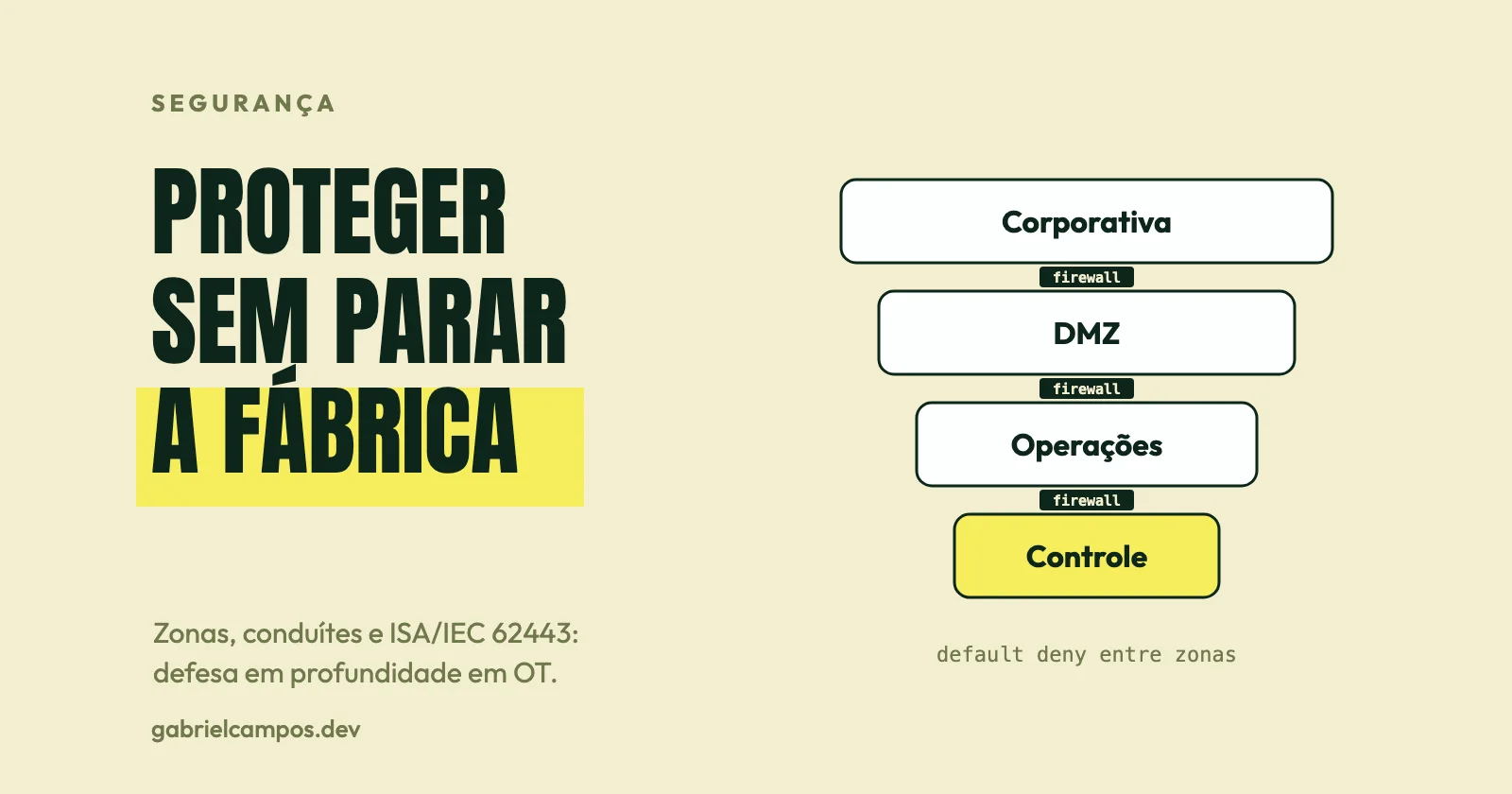
Previous articles in this series described an increasingly connected modern factory: controllers exposing telemetry via OPC UA, edge gateways publishing to message brokers, and enterprise cloud platforms ingesting real-time analytics. Every new connection solves an operational visibility bottleneck while simultaneously expanding the attack surface. This final article in the industrial automation series addresses how to secure operational technology without undermining what matters most: process continuity and physical safety.
A note on scope: this is a conceptual engineering study, not a site-specific security hardening guide. Real-world implementations require dedicated risk assessments conducted by engineers who understand the underlying physical process.
IT security versus OT security
NIST SP 800-82 Rev. 3 (September 2023) is the foundational operational technology (OT) security guide published by NIST. Its executive summary outlines how to secure OT “while addressing its unique performance, reliability, and safety requirements,” defining OT as programmable systems and devices that interact directly with the physical environment, such as industrial control systems (ICS), building automation, and transportation infrastructure.
That definition summarizes the core dilemma. Several practical contrasts (my synthesis based on established literature):
| Aspect | Enterprise IT | Industrial OT |
|---|---|---|
| Primary priority | Confidentiality, Integrity, Availability (CIA) | Operational safety and physical Availability first |
| Reboots / patching | Routine, short maintenance windows | Requires planned plant outages; often feasible only during annual turnarounds |
| Asset lifecycle | 3 to 5 years | Often 15 to 30 years |
| Timing & latency | Jitter-tolerant | Strict deterministic execution; microsecond sensitivities |
| Active scanners | Standard security practice | Can crash fragile legacy embedded network stacks |
| Consequence of failure | Data loss, financial and compliance impact | Production stoppage, equipment destruction, physical injury, environmental disaster |
| Endpoints | Modern, agent-supported operating systems | Embedded controllers and sensors unable to run security agents |
The engineering implication: enterprise IT security playbooks applied naively to OT environments often trigger the exact operational outages they were meant to prevent. An aggressive vulnerability scanner or an unverified reboot patch can easily trip an entire manufacturing line.
How an incident disrupts operational continuity
Malware does not need to compromise a physical PLC directly to bring an industrial plant to a dead stop. Two cases documented by official authorities demonstrate different failure modes:
- Colonial Pipeline (May 2021). CISA Alert AA21-131A documents a DarkSide ransomware attack originating within the corporate enterprise IT network of a major fuel pipeline operator. With no evidence at the time indicating compromise of the OT operational control network, the operator proactively shut down and disconnected certain OT systems to contain risk. US Congressional Research Service reports indicate this triggered a temporary shutdown of all pipeline operations, restored in phases days later. The engineering lesson: when IT and OT security perimeters are ambiguously bounded, an IT incident can trigger an operational plant shutdown simply out of precautionary necessity.
- Ukrainian Power Grid Cyberattack (December 2015). ICS-CERT/CISA alert IR-ALERT-H-16-056-01 (February 2016) details the cyber-induced power outages of December 23, 2015, across Ukrainian regional distribution companies. In this incident, adversaries breached supervisory control systems (SCADA) directly. Estimates of affected citizens vary across reports, and attribution is not stated in the US alert; hence neither is asserted here.
In both cases, resilient recovery hinged on identical foundational capabilities: accurate asset inventories, verified offline backups, the ability to operate systems in manual fallback mode, and rehearsed incident response plans.
ISA/IEC 62443
The ISA/IEC 62443 series is the global reference standard for Industrial Automation and Control Systems (IACS) cybersecurity. According to ISA, the standard was developed by the ISA99 committee in cooperation with IEC Technical Committee 65 Working Group 10; the ISA (ISA-62443-x-y) and IEC (IEC 62443-x-y) publications share identical technical content. Its foundational philosophy rests on shared responsibility distributed among asset owners, product suppliers, system integrators, and service providers.
Structural organization by parts (per ISA specifications):
- Part 1 (General): 1-1, terminology, concepts, and architectural models.
- Part 2 (Policies & Procedures): 2-1, asset owner security programs; 2-3, patch management (technical report); 2-4, security program requirements for IACS service providers.
- Part 3 (System): 3-2, security risk assessment for system design; 3-3, system security requirements and Security Levels (SL).
- Part 4 (Component): 4-1, secure product development lifecycle requirements; 4-2, technical security requirements for IACS components.
Zones, conduits, and security levels
Two central architectural concepts, summarized here from secondary engineering sources (verify definitions against full normative standard texts):
- A zone is a logical or physical grouping of cyber assets that share identical security requirements.
- A conduit is a dedicated communication path linking zones, which must provide security controls commensurate with the security levels of the zones it interconnects.
- Security Levels (SL 1 through SL 4) define target resistance against adversaries of increasing capability and resources, established via formal risk assessments. The standard specifies seven foundational requirements (FRs): identification and authentication control, use control, system integrity, data confidentiality, restricted data flow, timely response to events, and resource availability.
The zone-and-conduit paradigm is equally powerful as a software architecture discipline. The snippet below (Python, executed locally) models a conduit access control policy as an explicit whitelist (default deny) and evaluates observed network flows against it. It is an conceptual illustration of the mental model, not a network monitoring tool:
from dataclasses import dataclass

@dataclass(frozen=True)
class Flow:
    src: str; dst: str; proto: str; port: int    # src initiates connection to dst

ALLOWED = {                                       # default deny: only allow listed flows
    Flow("SUPERVISORY", "CONTROL", "opcua", 4840),
    Flow("OPERATIONS", "DMZ", "mqtt-tls", 8883),
    Flow("DMZ", "OPERATIONS", "https", 443),
    Flow("DMZ", "ENTERPRISE", "https", 443),
}

observed = [
    Flow("SUPERVISORY", "CONTROL", "opcua", 4840),
    Flow("OPERATIONS", "DMZ", "mqtt-tls", 8883),
    Flow("ENTERPRISE", "CONTROL", "rdp", 3389),
    Flow("ENTERPRISE", "OPERATIONS", "smb", 445),
]
for f in observed:
    print("OK       " if f in ALLOWED else "VIOLATION", f)
In execution, the first two flows are permitted, while the last two—direct RDP access from enterprise IT into field controllers and SMB file sharing into plant operations—are flagged as security violations. The value lies in making network policies explicit: if system architects cannot enumerate which network flows should exist, identifying anomalies is impossible.
Defense in depth for OT
Defense in depth dictates never relying on a single defensive barrier. A conceptual, illustrative topology:
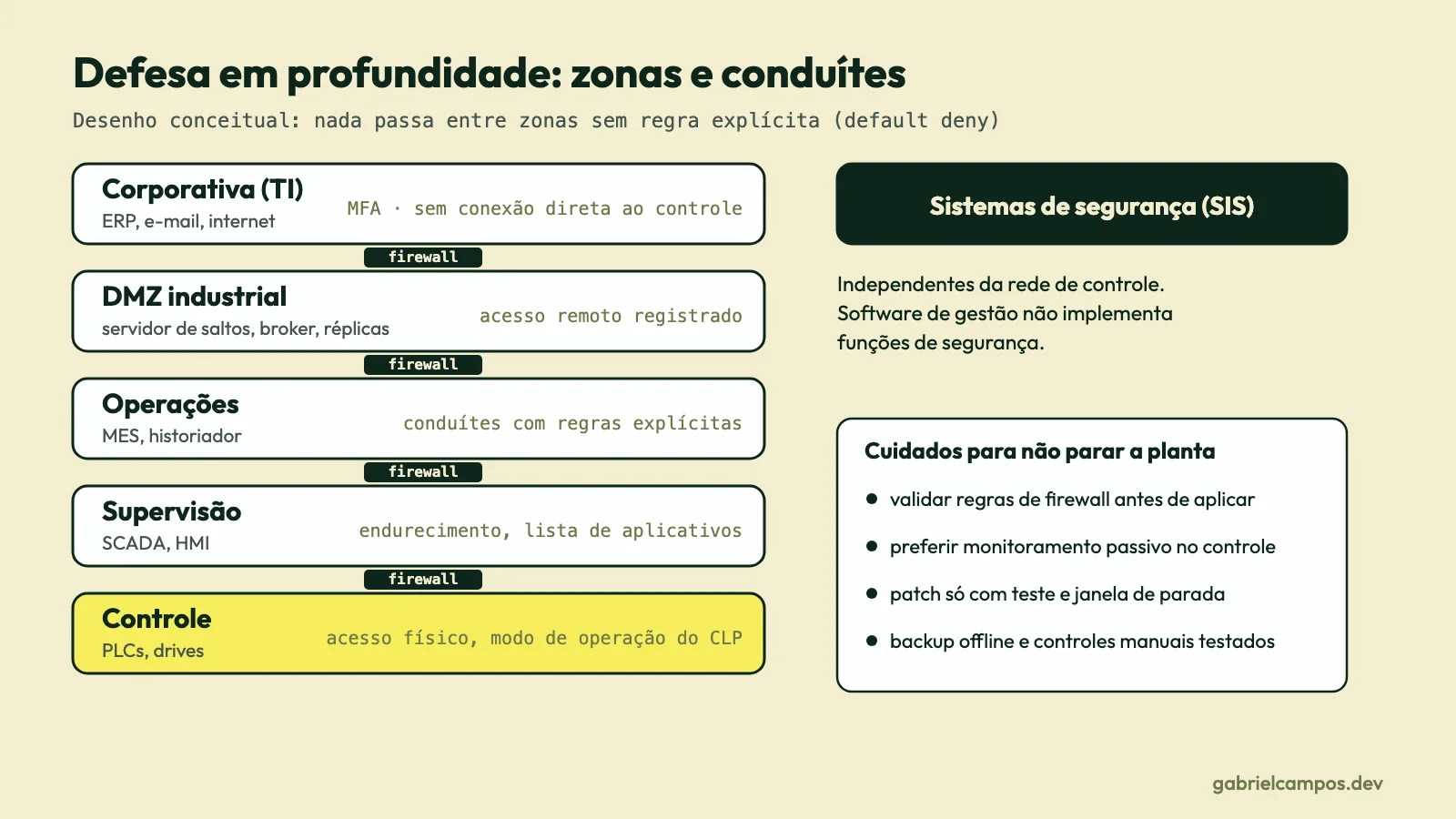
Architectural layers and operational safeguards, emphasizing preserving availability and physical process safety:
Network segmentation and firewalls. Strictly decouple corporate IT from industrial OT, and segment internal OT networks by operational function. CISA ransomware advisories consistently recommend robust IT/OT segmentation mediated by an industrial demilitarized zone (IDMZ) that terminates all direct peer-to-peer traffic. An operational caveat: poorly planned firewall rules can break cyclic deterministic industrial protocols. Always validate rules in staging testbeds or during scheduled maintenance turnarounds with explicit rollback procedures.
Identity and access management. Enforce the principle of least privilege, deploy individual (non-generic) user accounts wherever platforms support them, separate operational operator roles from engineering workstation rights, decommission dormant accounts, and maintain audit logs. Many legacy control assets only support shared hardcoded credentials; in those scenarios, enforce compensating controls at the network and physical barrier levels. This is general operational best practice (opinion), rather than normative text from a single standard.
Authentication. CISA strongly recommends multi-factor authentication (MFA) for remote access into both IT and OT networks. For shop floor operators wearing personal protective equipment at shared terminals, smartphone-based authenticators or long passwords may be ergonomically unworkable; authentication schemes must align with plant operational reality (badge tap cards, hardware tokens, terminal physical isolation).
Remote access and secure connectivity. Vendor and remote engineering access represents a primary ingress vector. Recommended practices aligned with government guidance: channel all inbound access through an IDMZ jump host with MFA, session recording, strict time-boxed windows, and granular destination asset scoping; avoid direct public-facing RDP (restrict source IPs and mandate MFA when unavoidable). In January 2026, international cybersecurity agencies across eight nations (including CISA, the FBI, the UK NCSC, Germany’s BSI, and the Canadian Centre for Cyber Security) published joint guidance on secure connectivity principles for operational technology; consult the official publication for the unabridged principles. A VPN encrypts the transport tunnel, but it cannot replace internal segmentation or authorization once an endpoint connects.
Passive network monitoring. Implement non-intrusive traffic capture (switch SPAN port mirroring, specialized OT intrusion detection sensors) to discover unmanaged assets, maintain dynamic hardware inventories, and alert on out-of-policy conduit flows. Prioritizing passive inspection over active scanning on Level 1 and Level 2 networks ensures fragile embedded controller stacks are never destabilized. Actionable alarm triage processes matter far more than monitoring software tooling.
Hardening PLCs and SCADA. Reduce attack surfaces: remove direct internet routing, change factory default passwords, disable unused services and protocols, place physical PLC CPU mode keyswitches (when present) into RUN rather than REMOTE/PROGRAM mode, enforce physical cabinet access controls, and monitor logic project file modifications. On SCADA/HMI hosts: enforce OS hardening, application whitelisting, and strict USB mass storage device restrictions. Practical hardening scope depends strictly on vendor capabilities.
Vulnerability management and legacy hardware. Decades-old industrial equipment cannot be patched, or the manufacturer has ceased maintenance. The appropriate response is compensating controls: isolate legacy assets within dedicated micro-segmented sub-zones, restrict inbound communications via firewalls, and monitor telemetry closely. ISA/IEC 62443 covers secure product development lifecycles (4-1) and component technical requirements (4-2), providing procurement criteria when specifying new hardware.
Patch management. ISA-62443-2-3 provides guidelines for IACS patch management. The central discipline is process: maintain accurate inventories, track vendor security bulletins, perform risk assessments evaluating both the vulnerability and the operational disruption of applying the patch, test in an identical staging environment, execute updates within scheduled plant shutdowns, and maintain regression rollback plans. Not every patch should be deployed immediately in OT; consciously deferring an update while deploying compensating perimeter controls is an entirely legitimate risk strategy.
Backups and disaster recovery. CISA Alert AA21-131A highlights maintaining regular, tested, and offline backups physically segregated from connected networks. In OT, backup scope extends far beyond databases: PLC ladder projects, SCADA/HMI project archives, process recipes, MES databases, and golden images of engineering workstations. A backup that has never been successfully restored in a dry run is merely a hypothesis, not a backup. CISA also emphasizes regularly validating manual fallback controls, ensuring critical operational functions can sustain production if OT networks must be taken offline.
Incident response. An OT-specific incident response plan must define: who possesses the operational authority to isolate or halt plant systems (as Colonial Pipeline demonstrated, shutdown decisions are frequently made proactively), emergency communication protocols with plant managers, process safety officers, and equipment vendors, procedures for transitioning to manual islanded operation, evidence preservation that does not stall physical recovery, and regulatory reporting triggers. Rehearsing tabletop exercises uncovers coordination gaps before an actual incident occurs.
Relationship with other frameworks
- ISA/IEC 62443: the definitive benchmark of requirements and processes for industrial automation, structured across stakeholder roles (asset owner, system integrator, product supplier) and security tiers.
- NIST SP 800-82 Rev. 3: comprehensive US guidance for securing OT environments, offering reference architectures, threat catalogs, vulnerabilities, and countermeasures, including an OT-specific overlay for NIST SP 800-53 security controls.
- Government agency guidance (CISA, NCSC, and international partners): actionable tactical recommendations covering RDP mitigation, MFA enforcement, offline backups, and secure remote connectivity principles.
These frameworks complement one another: ISA/IEC 62443 and NIST SP 800-82 provide overarching programmatic governance, while agency alerts supply timely tactical priorities. General corporate information security standards (such as ISO/IEC 27001) also exist, but were not evaluated in depth for this specific comparative study.
Relationship with software engineering
For developers building industrial software, security is an architectural requirement: fine-grained user authentication and role-based access control inside the MES; fieldbus communication leveraging native cryptographic capabilities (e.g., OPC UA with X.509 certificates and SignAndEncrypt policies, rather than unauthenticated endpoints); secrets kept out of source repositories; immutable audit trails; updated software dependencies; edge gateways treated as managed, patchable operating systems; and secure development lifecycles guided by IEC 62443-4-1. And the rule most frequently overlooked in rushed sprints: every new system integration constitutes a new network conduit between zones, and must be explicitly engineered, evaluated, and documented as such.
Conclusion
Industrial cybersecurity is fundamentally a discipline of sound architectural design and disciplined operational practice: maintaining complete asset visibility, segmenting networks into discrete zones, policing conduits, managing remote vendor access as a high-risk vector, deploying compensating controls around unpatchable legacy systems, and rigorously rehearsing disaster recovery and manual plant operations. Applying security measures without understanding the underlying physical process risks tripping the plant; neglecting security invites enterprise IT incidents to spill into operational shutdowns. Resilient security is achieved by collaborating directly with automation engineers, rather than imposing IT policies from above.
This article concludes the industrial automation series. The software architecture overview serves as the logical starting point for readers wishing to review the full series in sequence.
References
This article is a study based on the sources below. Passages marked as opinion reflect my own reading. This is not a site-specific implementation guide; actual deployments require plant-specific risk assessments. The code snippet was tested locally.
- NIST. SP 800-82 Rev. 3, Guide to Operational Technology (OT) Security, September 2023.
- ISA. ISA/IEC 62443 Series of Standards. The zone, conduit, and security level concepts summarized here reflect secondary technical literature rather than direct normative extracts.
- IEC. IEC 62443-4-1:2018 (catalog).
- CISA. AA21-131A, DarkSide Ransomware: Best Practices for Preventing Business Disruption from Ransomware Attacks.
- Congressional Research Service. Colonial Pipeline: The DarkSide Strikes.
- CISA/ICS-CERT. IR-ALERT-H-16-056-01, Cyber-Attack Against Ukrainian Critical Infrastructure. Full text not independently verified in this research.
- Canadian Centre for Cyber Security and partners (CISA, FBI, NCSC-UK, ASD ACSC, BSI, NCSC-NL, NCSC-NZ). Joint guidance on secure connectivity principles for operational technology, updated January 2026.
- OPC Foundation. OPC 10000-2, Security.
Need technical support for your software architecture or systems?
I build resilient custom web systems, high-throughput API integrations, and performance diagnostics. Direct collaboration with the engineer, zero intermediaries.
Related Articles

MES, ERP, SCADA, and Historians: Differences and Integration
A technical comparison of MES, ERP, SCADA, and data historians: inputs, outputs, how they integrate, and what breaks when integration fails.

Software Architecture of a Modern Factory: From Sensor to ERP
How sensors, PLCs, SCADA, MES, historians, and ERP fit together, the ISA-95 standard, and the path of production data from the shop floor to enterprise IT.