AEO: How to Structure Content to Become the Direct Answer
What Answer Engine Optimization is, how snippets and AI assistants extract answers from pages, and how to write content with direct answers without gimmicks.

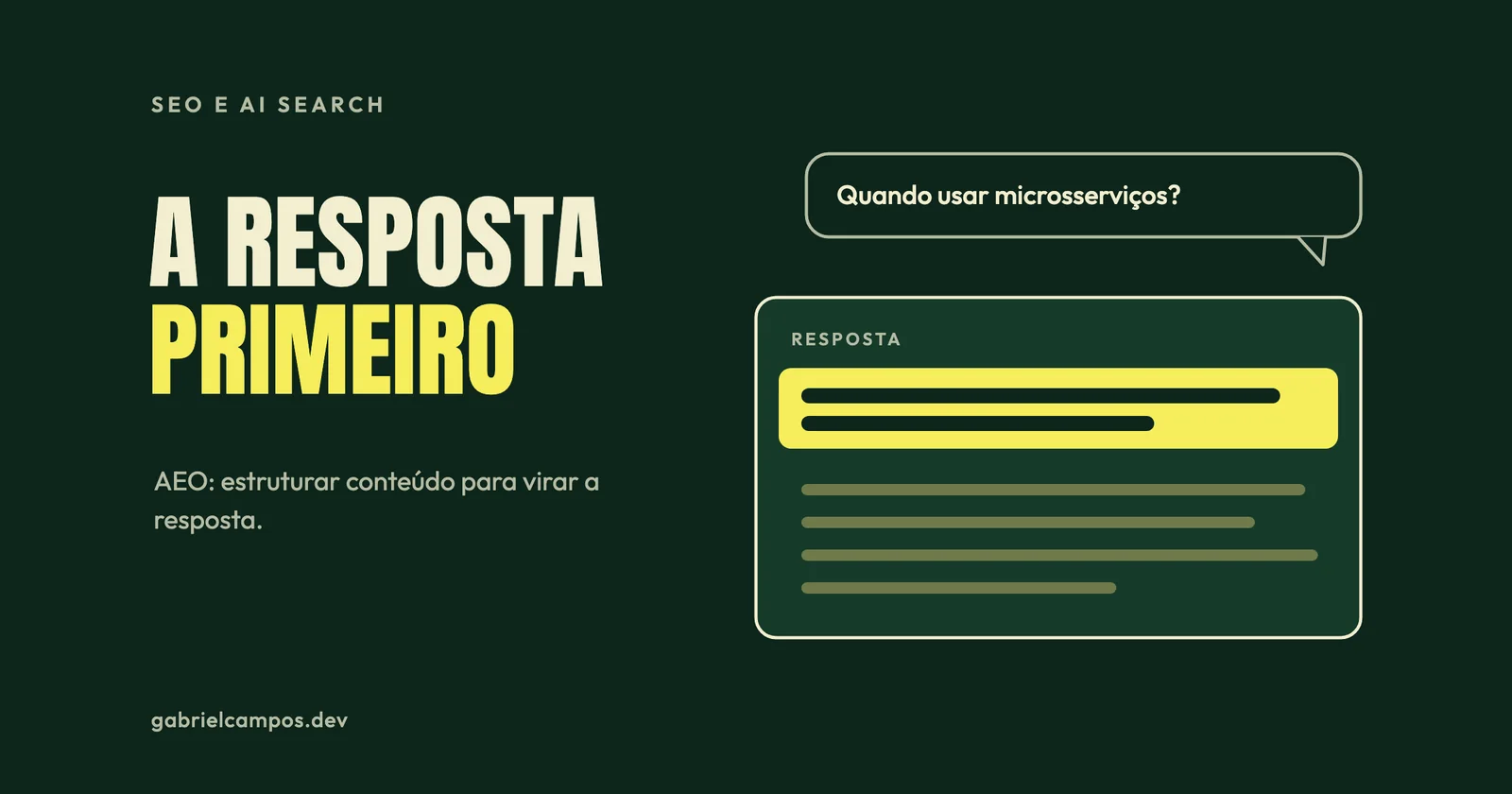
Short answer: AEO (Answer Engine Optimization) is the practice of structuring web content so that question-answering systems can reliably extract an accurate, comprehensive direct answer. This encompasses Google’s featured snippets, AI Overviews on search engines, and conversational assistants like ChatGPT, Copilot, and Perplexity. In practice, AEO does not replace SEO: it is high-quality SEO, featuring content formatted as direct questions and answers.
I opened this article with the direct answer intentionally. That is precisely the design pattern it advocates.
Where the Term AEO Comes From
AEO is an industry marketing term, not an official Google designation. It gained traction when search engines began answering queries directly on the search results page (featured snippets, “People Also Ask” accordions, voice search results), and accelerated with the emergence of generative AI search syntheses.
The critical takeaway: none of these systems require a separate set of technical tricks. Google explicitly notes in its documentation on AI features in search that there are no additional requirements or secret optimizations needed to appear in AI Overviews or AI Mode. The page simply needs to be indexed and eligible to display a snippet. The remainder comes down to foundational web standards and editorial clarity.
What genuinely changes is content format. Question-answering systems digest granular text fragments rather than processing the entire page as a monolithic document.
How Answer Engines Select Source Passages
Google Featured Snippets
Featured snippets are generated algorithmically. According to official documentation, Google’s systems determine whether a page would serve as a high-quality highlight for a given query. There is no special schema markup to request selection; you cannot programmatically “apply” for a featured snippet. You can only opt out using the nosnippet meta tag (guaranteed) or by limiting character length via max-snippet (heuristic).
AI Assistants and Conversational Search
In October 2025, the Bing engineering team published guidance on the Microsoft Advertising blog detailing how content is retrieved for AI-generated answers. The core principle: AI assistants do not read long-form web pages sequentially from top to bottom. They segment content into smaller semantic chunks and evaluate each passage in isolation. Hence their recommendation to maintain modular sections, concise standalone answers, and sentences that preserve complete semantic meaning outside their original context.
This aligns directly with what has always worked for featured snippets: a crisp question followed by an unambiguous answer.
How to Write Content That Becomes the Chosen Answer
1. Frame Headings as Specific Questions
Headings act as chapter dividers: they define where a discrete concept begins and ends. “Learn more” communicates nothing to an extraction parser. “How long does a legacy system migration take?” communicates exactly what follows.
2. Answer in the First Two Sentences
Directly beneath each question heading, provide the direct answer in one or two clear sentences. Expand subsequent details afterward: context, edge cases, real-world examples, and citations. This is the classic journalistic inverted pyramid applied to every individual section.
3. Write Context-Independent Sentences
Avoid phrasing like “as stated above” or ambiguous pronouns (“this”) lacking clear referents. If an automated scraper isolates a single paragraph, that snippet must remain factually accurate and self-contained.
4. Use Lists and Tables for Structured Information
Sequences of steps, feature comparisons, and technical criteria belong in markdown tables or bulleted lists. Narrative prose remains ideal for deeper explanations and architectural arguments.
5. Be Specific and Cite Primary Sources
“Significantly reduces latency” is vague marketing fluff. “Reduced p99 latency from 40–125 ms down to approximately 15 ms, according to Discord’s engineering team” is specific, quantifiable, and auditable. Numbers without source attribution invite skepticism from human readers and retrieval algorithms alike.
Before and After
An example of a vague, poorly extractable section:
## Considerations

There are many variables involved, and as mentioned earlier,
it depends heavily on the project context. In general, it is
worth thinking carefully before deciding...
And the exact same section restructured as an extractable answer:
## When should you adopt microservices?

Microservices make sense when independent teams need to deploy
distinct business capabilities autonomously, and the organization
already has automated CI/CD pipelines and centralized observability.

Warning signs that it is too early:

- A single engineering team maintains the entire platform;
- Deployments are executed manually;
- There is no distributed tracing or centralized metrics.
Technical Architecture That Helps (or Hurts)
- Semantic, visible HTML. Microsoft’s guidelines explicitly warn that AI extraction systems frequently bypass content buried inside hidden tabs or accordion widgets. Critical technical information locked inside flattened raster images or PDFs is equally prone to being overlooked.
- Harmonized Title, H1, and Meta Description. All three elements should describe the exact same topical scope using natural, accessible language.
- Accurate structured data. Schema.org markup in JSON-LD syntax assists search parsers in classifying entities (articles, tech products, FAQs). Markup must strictly mirror what human visitors see on screen. Keep in mind: since August 2023, Google only awards FAQ rich snippets to authoritative government and healthcare organizations. Use
FAQPageschema only when an authentic FAQ exists on the page, never as a ranking shortcut. - Permissive crawler access. A URL disallowed in
robots.txtcannot be evaluated for answers. This applies equally to AI search indexers, such as OpenAI’sOAI-SearchBot(which I discuss further in my GEO article).
Finding the Right Questions to Answer
Effective AEO originates from real user pain points, not synthetic keyword spreadsheets. High-leverage sources include:
- Google Search Console: Long-tail queries formatted as explicit questions that already trigger impressions for your domain.
- “People Also Ask” accordions: On SERPs matching your core technical domains.
- Sales and customer support conversations: Technical objections and inquiries prospective clients raise before signing contracts represent high-intent questions.
- Developer communities and specialized forums: Where your target audience debates real implementation hurdles.
In my experience, sales and discovery calls are the most underutilized content engine. Any technical question asked repeatedly during client consultations deserves a dedicated, honest webpage answering it thoroughly.
Measuring Answer Engine Performance
Measuring AEO is more challenging than traditional SEO because significant value is realized without an outbound click: users digest the answer directly and proceed with their day (zero-click searches). Practical signals to monitor include:
- Impression trends and CTR on question-based queries within Google Search Console;
- Referral traffic originating from conversational AI domains in analytics dashboards;
- Periodic manual spot-checks: querying AI assistants regarding your subject matter and documenting timestamps, citations, and summaries. This represents qualitative benchmarking rather than deterministic analytics.
Common Pitfalls
- Bloated FAQ blocks: Inserting dozens of low-effort questions solely to justify
FAQPageschema markup. - Buried answers: Writing three paragraphs of discursive filler before addressing the question stated in the headline.
- Disembodied answers: Generic, unverified text lacking transparent authorship, documented testing, or real-world experience.
- Writing for bots: Robotic, stilted phrasing repeating the exact query verbatim. If it sounds unnatural to a human engineer, it is wrong.
Further Reading
AEO is built squarely upon foundational SEO, which I analyze in SEO in 2026: What Google Documentation Actually Recommends. The subsequent step is examining academic research on citations in conversational AI models, detailed in my guide on GEO (Generative Engine Optimization).
References
This article is a technical study based on the primary sources below. Sections marked as opinion reflect my own analysis.
- Google Search Central. AI features and your website.
- Google Search Central. Featured snippets and your website.
- Google Search Central Blog. Changes to HowTo and FAQ rich results (August 2023).
- Krishna Madhavan, Microsoft Advertising Blog. Optimizing your content for inclusion in AI search answers (October 2025).
- Bo Ingram, Discord. How Discord Stores Trillions of Messages (March 2023), latency case study source.
- OpenAI. Overview of OpenAI Crawlers.
Need technical support for your software architecture or systems?
I build resilient custom web systems, high-throughput API integrations, and performance diagnostics. Direct collaboration with the engineer, zero intermediaries.
Related Articles
GEO: What Peer-Reviewed Research Reveals About AI Search Citations
Generative Engine Optimization based on the original KDD 2024 paper: experimental setup, what worked, study limitations, and what to apply today.
SEO in 2026: What Google Documentation Actually Recommends
SEO from primary sources: crawling, helpful content, titles, links, structured data, and the myths Google explicitly debunks in its documentation.